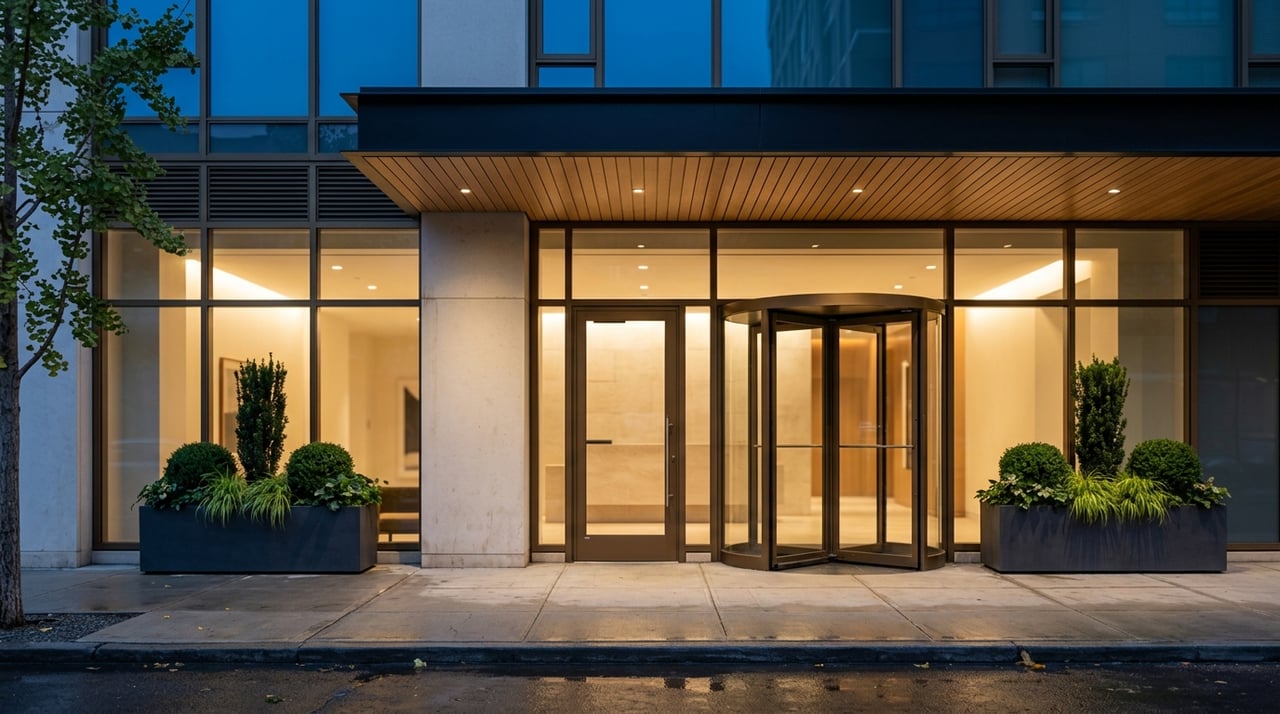

A buyer touring new construction in Midtown East this month is likely comparing two numbers: the price per square foot on the listing sheet, and the maintenance or common charges quoted by the sales office. Those are the numbers that get discussed on the tour. The number that actually determines what gets wired at closing sits somewhere else entirely, buried in the offering plan's closing cost schedule, and it has almost nothing to do with the finishes or the view.
Here is what that number reveals. Across the roughly 90 active new-development listings in Midtown East, the median asking price sits at just over $2 million. That figure lands within a few thousand dollars of one of the sharpest cliffs in New York State's real estate tax code, and it lands squarely inside a submarket where sponsor contracts routinely shift costs onto buyers that a resale buyer of the identical apartment would never pay. Neither fact shows up in the listing. Both are the reason a Midtown East new-development closing can run tens of thousands of dollars heavier than a resale purchase at the exact same contract price.
The Cliff, Not the Slope
New York's mansion tax gets described casually as a graduated tax, the way federal income brackets work. It is not. It is a whole-price tax. Once the contract price crosses a threshold, the bracket rate applies to the entire purchase price, not the amount above the line.
For 2026 closings, the residential brackets run like this:
| Purchase Price | Mansion Tax Rate |
|---|---|
| $1,000,000 – $1,999,999 | 1.00% |
| $2,000,000 – $2,999,999 | 1.25% |
| $3,000,000 – $4,999,999 | 1.50% |
| $5,000,000 – $9,999,999 | 2.25% |
| $10,000,000 – $14,999,999 | 3.25% |
| $15,000,000 – $19,999,999 | 3.50% |
| $20,000,000 – $24,999,999 | 3.75% |
| $25,000,000 and up | 3.90% |
A contract at $1,995,000 owes $19,950. A contract at $2,010,000, fifteen thousand dollars more expensive, owes $25,125. The buyer paid 0.75% more for the apartment and 26% more in tax. This is the well-known part of the story, and it is why brokers everywhere talk about negotiating a dollar off a round number near a threshold.
The New York State Department of Taxation and Finance confirms the mechanics directly: the additional tax applies to the full consideration once a residential sale reaches $1 million, with no phase-in. What gets missed in Midtown East specifically is that a meaningful share of the neighborhood's new-development inventory sits directly on top of the $2 million line, which means the cliff is not a rare edge case here. It is the median.
The Second Line Sponsors Add
The mansion tax bracket is the part every buyer eventually learns about. The part that surprises people at the closing table is different: it is not a tax bracket at all, it is a contract clause.
In a standard resale, New York City's Real Property Transfer Tax and New York State's Real Estate Transfer Tax are seller costs. That is the market convention, full stop. A buyer closing on a resale co-op or condo in Midtown East does not write a check for either one.
New construction runs on a different convention. Because the sponsor is the seller, and the sponsor writes the contract, offering plans routinely require the buyer to absorb both transfer taxes, roughly 1.425% for the city tax and 0.4% for the state tax on a sub-$3 million contract, a combined 1.825%. On a $2,010,000 sponsor contract, that is another $36,700 that a resale buyer down the street, closing on an identical layout in an older building, would never see.
Run both lines together on that same $2,010,000 sponsor contract and the tax exposure looks like this: $25,125 in mansion tax plus roughly $36,700 in shifted transfer taxes, before mortgage recording tax on any financing, before the sponsor's attorney fee (typically $2,500 to $3,500), before a working capital contribution that usually runs two months of common charges. A resale buyer at the same $2,010,000 price point owes the mansion tax and nothing else on that list. The new-development buyer's tax bill is more than double, and the apartment itself has nothing to do with it.
Why This Bites Hardest in This Particular Neighborhood
Midtown East's new-development pipeline did not appear at random. Much of it followed the East Midtown rezoning, which redirected development capacity and public investment toward the district around Grand Central, including the 2025 completion of Pershing Square Plaza's pedestrian upgrades. Add the 2023 arrival of full Long Island Rail Road service through Grand Central Madison and the neighborhood picked up a wave of condo product aimed at commuters and pied-à-terre buyers rather than only trophy-tier towers.
That matters for this thesis because it explains why the median sits where it does. The Park Avenue trophy corridor, 432 Park, 520 Park Avenue, 100 East 53rd, and the Waldorf Astoria Residences, trades at price points where the mansion tax bracket cliffs still cost real money but blur against seven-figure and eight-figure totals. The bulk of the neighborhood's new construction is not that. It is the mid-tier product built around the rezoning and the transit upgrades, priced in the low seven figures, which is exactly the band where a $15,000 difference in contract price can mean a five-figure difference in tax owed.
The Pre-War Co-op Alternative Sits a Tier Below This Entirely
Midtown East is roughly split between condo product and pre-war co-op stock concentrated in Sutton Place, Beekman, and the East 50s along Park, Madison, and Lexington, where renovated full-service apartments generally trade in the $1,500 to $3,000 per square foot range. A resale co-op purchase in that submarket sidesteps both problems in this piece at once. Co-op purchases are stock transactions, not deed transfers, so there is no mortgage recording tax regardless of financing. And because they are resales rather than sponsor sales, the seller pays the transfer taxes under standard market convention.
The mansion tax still applies to co-ops above $1 million, calculated on the allocated value of the shares rather than a deed price, so that piece of the math does not disappear. But the sponsor-shift problem does, entirely, because there is no sponsor. For a buyer weighing new construction near Grand Central against a renovated Sutton Place co-op at a comparable price, the closing cost gap between the two options is often larger than the price-per-square-foot gap that gets discussed on the tour.
What Sponsors Will Actually Move
None of this is fixed. Sponsors negotiate, particularly once a building has been in sellout for a while and absorption slows. Attorneys who work regularly on New York offering plans describe sponsors becoming more willing to cover the buyer's transfer taxes outright, offer a year of common charges, or hand back a closing credit rather than cut the headline price, especially in a rate environment where financed buyers are already stretched. That willingness tends to show up later in a building's sales cycle, not on day one of a launch, which is one more reason the timing of an offer in a Midtown East new development matters as much as the unit itself.
The math above is not a reason to avoid new construction in this neighborhood. It is a reason to read the offering plan's closing cost page before writing an offer, not after signing a contract, and to treat the contract price as the start of the conversation rather than the end of it.
Frequently Asked Questions
Does the mansion tax apply the same way to co-ops and condos? Yes, in both cases it is the buyer's obligation on residential purchases at $1 million or more, calculated on the full purchase price at the applicable bracket. For co-ops, the taxable basis is calculated on the allocated share value plus any proportional share of the building's underlying mortgage, which can make the effective mansion tax on a co-op somewhat different from a condo at the same headline price.
Can a buyer negotiate the sponsor out of the transfer tax shift? Sometimes, particularly on inventory that has been sitting or in buildings well past their initial sellout window. It is rarely offered upfront and almost always requires a specific ask before signing.
Is the $1 mansion tax negotiation trick, dropping a contract from $2,000,000 to $1,999,999, actually meaningful? On a whole-price bracket structure, yes. Dropping one dollar moves the entire contract out of the 1.25% bracket and into the 1.00% bracket, worth roughly $5,000 in tax on a $2 million contract, which is a real number to raise before a final price is agreed, not after.
Closing cost math like this is exactly the kind of detail that separates a comfortable closing from a scramble for extra funds at the table, and it is easy to miss when the focus stays on layouts and amenities. If you are weighing new construction against a resale co-op in Midtown East, or trying to read a specific offering plan before you make an offer, the Sapir Team can walk through the actual numbers on the building you are considering. Book a private consultation before you sign anything.